Bouldering for Beginners: Getting Started Without Ropes or Complicated Gear
Walk into any climbing gym on a weekend afternoon and the bouldering section is where the energy is. People are clustered in groups of two and three around specific problems, running moves, falling onto thick pads and getting up laughing, arguing about foot position on a particular sequence, cheering when someone finally sticks the crux after twenty tries. The atmosphere in a good bouldering gym is something between a puzzle club and an athletic competition, social and intensely physical at the same time.
Bouldering is the fastest-growing form of climbing in the United States, partly because it appeared in the 2021 Olympics in Tokyo, but mostly because the barrier to entry is genuinely low. You need climbing shoes, chalk, and access to a wall or a boulder. No rope, no belay certification, no extensive gear investment. You can walk into a gym today with no prior experience and be climbing within an hour.
The Basic Format
Indoor bouldering takes place on walls ranging from vertical to aggressively overhanging, typically between 12 and 15 feet tall, with thick foam crash pads covering the floor beneath. Routes on bouldering walls are called problems, and they are typically set with a single color of hold so that you can distinguish which holds belong to your problem from the surrounding mix. Problems are graded on the V scale in the United States, beginning at VB for the most basic introductory sequences and running through V0 to V3 for beginner and intermediate climbers, V4 to V7 for advanced, and V8 and above for elite territory. World-class competition bouldering currently reaches V16 and V17 at the absolute cutting edge of what is humanly possible.
Outdoor bouldering takes place on natural rock formations, typically in concentrated areas called bouldering fields that have been documented and graded by the local climbing community. Classic American bouldering areas include Hueco Tanks in West Texas, known for its extraordinary quality of featured granite and sandstone; Bishop in the eastern Sierra Nevada of California, famous for its volcanic tuff and granite bouldering across multiple distinct areas; Horse Pens 40 in Alabama, a beloved sandstone bouldering area in the South with a long history; and Rocktown in Georgia, a concentrated sandstone area with excellent beginner and intermediate terrain.
Footwork: Where Most Beginners Go Wrong
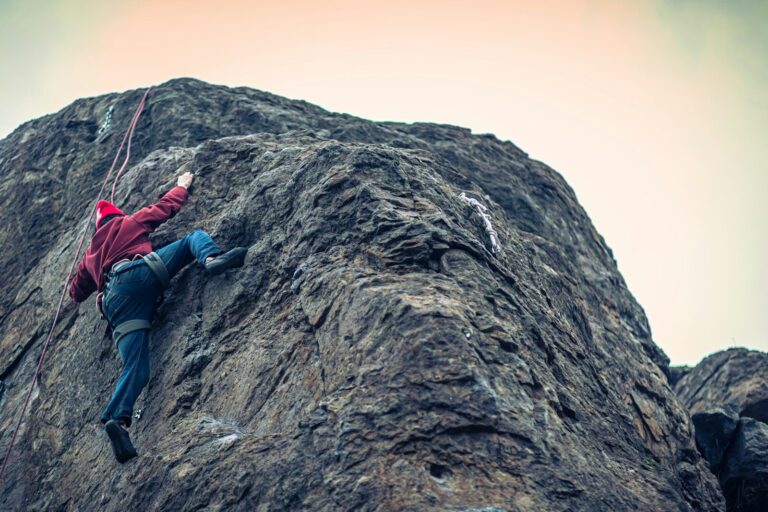
The most persistent and consequential mistake new bouldering climbers make is treating the activity as primarily an upper body workout. This is understandable because the arms are doing something visible and effortful, but it produces a plateau in performance and a style of climbing that is far harder than it needs to be. The correct understanding: bouldering is primarily a footwork and body positioning activity. The arms are for balance and direction-change; the feet and legs are for generating the upward force.
The foundational movement principle is keeping your weight over your feet. Imagine a plumb line dropped from your center of gravity to the floor; it should pass through your feet, not hang in space between you and the wall. When your weight is over your feet, the contact between your shoes and the holds is supported by your skeleton and gravity, not by muscular tension in your arms and shoulders. When your weight hangs off the wall unsupported by your feet, you are essentially doing a continuous pull-up for the duration of the climb. The difference in energy expenditure is enormous over the course of a session.
Look at the foothold before you step on it, every time. Choose the specific point on your shoe to contact the specific point on the hold that will give you the most friction and the best body position. Beginners typically look at the handhold they are reaching for and feel around with their feet for something solid. Advanced boulderers look at their feet as often as their hands and place each foot with deliberate precision before weighting it.
Falling and Safety
Learning to fall on a bouldering pad is a real skill that protects you from injury. The reflex to catch yourself with outstretched hands and locked wrists is responsible for a significant percentage of bouldering injuries, particularly wrist fractures and sprains. The safer reflex is to land on your feet with bent knees and let your legs absorb impact rather than extending your arms to catch yourself.
When a fall takes you off an overhang and you cannot control a feet-first landing, the trained response is to tuck and roll, distributing impact across your back and shoulders rather than a single point, and keeping your arms close to your body rather than extending them to break the fall. Practice intentional falling on low problems where the consequence of an imperfect landing is minimal, so the falling mechanics become automatic before you need them on something harder.